Accepting payments is not as simple as creating an account.
Before a business can start processing transactions, payment providers must collect, verify, and assess information from multiple documents, participants, and verification processes.
Payvanta helps merchants complete onboarding with confidence. This case study covers how registration and identity verification were designed as a connected sequence within a single onboarding ecosystem.
Based on real-world onboarding and compliance workflows. Some details have been modified to protect confidential information.

Two sides of the process want opposite things. Merchants want to start accepting payments quickly with as little friction as possible. Compliance teams need enough verified information to assess risk before any account can be activated.
Without a structured process, applicants can struggle to understand requirements, and reviewers can spend significant time gathering and validating information. The result is a slower onboarding experience for everyone involved.
Applicants may be individuals or registered companies, and each path carries different verification requirements. For juristic entities, directors are required participants and must each complete identity verification independently before the application can proceed. See how we designed for each.
Complete onboarding quickly and understand exactly what is required to get approved.
Complete identity verification so the application can proceed.
Collect verified information to assess risk and meet AML and regulatory requirements before approving a merchant account.
This case study focuses on two connected components: the merchant registration flow that collects application data, and the eKYC system that verifies identity before an account can be approved.
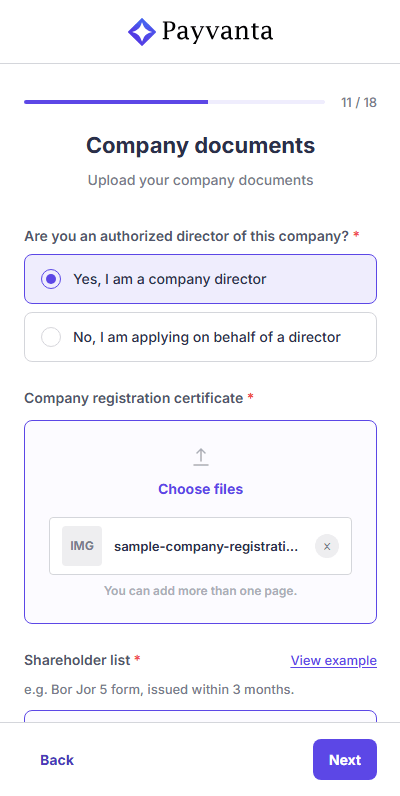
Merchants submit business details, contact information, and account preferences. This information drives all downstream verification and review processes.
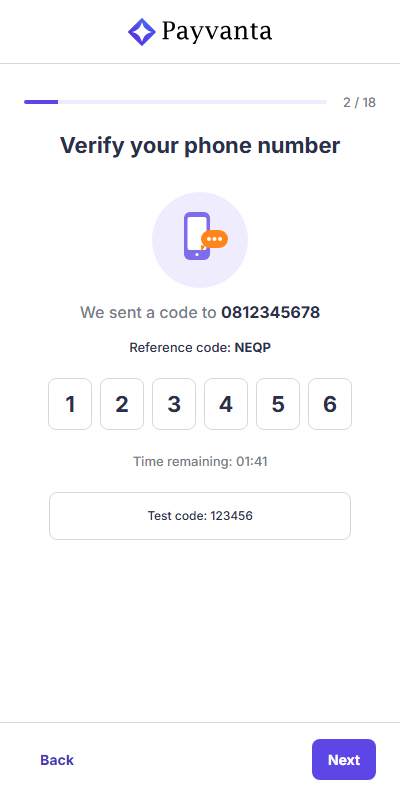
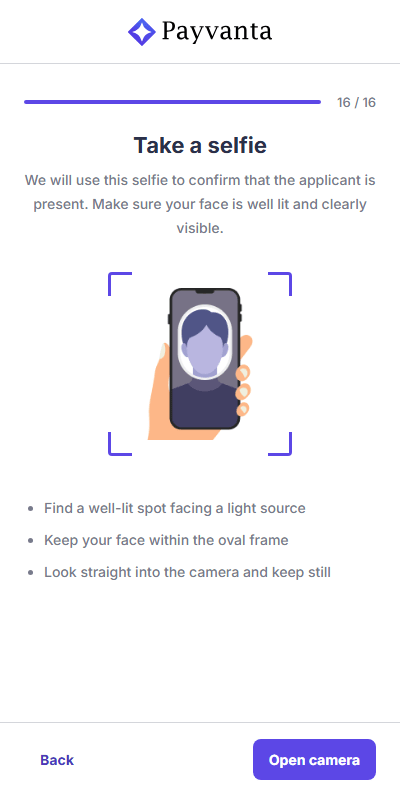
Applicants and directors verify their identity through ID capture and liveness checks. Results are shared with compliance reviewers as part of the approval process.
Both paths end at the same reviewer workspace. The key difference is that juristic entities require director identity verification before the parallel verification tracks begin.
Usability testing ran across 8 participants: 2 moderated, 6 unmoderated. Each session covered the full onboarding flow through to eKYC completion, with one forced fail and one pass for both ID document capture and liveness. The prototype reached 100% form completion rate, a result shaped by motivated participants and a system that had been iterated to resolve known friction before testing began.
The working prototype covers the full merchant registration flow and the director identity verification experience. Each component was designed independently but built to hand off cleanly to the next. See what testing changed →
This case study covers registration and identity verification. Each module was designed independently and built to hand off cleanly to the next.
Maps the onboarding process across five phases and three actor lanes: the merchant, directors (juristic entities only), and the system. Shows what each actor does, where work happens in parallel, and how the process hands off to the reviewer.
Organizes all information collected during onboarding into four categories, branching from the application root to individual fields.
Cross-references each onboarding step against the four data categories and system actions. Juristic-only steps are marked with a brand-colored left border.
| Step | Identity | Business | Financial | Documents | System |
|---|---|---|---|---|---|
| Contact details | |||||
| Phone + email OTP | |||||
| Terms + privacy | |||||
| Account type | |||||
| Shop profile | |||||
| Sales + photos | |||||
| Payment + refund | |||||
| Company documents | |||||
| Company profile | |||||
| Settlement account | |||||
| eKYC consent | |||||
| ID card scan | |||||
| Selfie / liveness |
Each document serves a specific verification purpose. The required set varies by applicant type and answers given during the form.
| Document | Required for | Issued by | Purpose |
|---|---|---|---|
| National ID card Front + back |
All | Thai government | Identity verification. OCR extracts name, ID number, DOB, and address. Selfie is compared against the ID photo for liveness. |
| Bank book / statement | All | Any Thai bank | Confirms settlement account ownership. Account name, number, and bank name must be visible and match the submitted details. |
| Storefront + product photos | All | Applicant | Evidence of business existence. Physical shops: show frontage with visible sign. Online sellers: screenshot of website or social page. |
| Company registration cert Issued within 3 months |
Juristic | DBD (กรมพัฒนาธุรกิจ) | Confirms legal entity status. Used to auto-prefill company name, registration number, and registered address in "Individual profile". |
| Shareholder list (Bor Jor 5) Issued within 3 months |
Juristic | DBD | Identifies authorized directors and ownership structure. Used to auto-prefill the director list for eKYC assignment in "Company directors". |
| VAT certificate (Por Por 20) | Juristic, if VAT-registered | Revenue Department | Confirms VAT registration status. Only required if the business answers yes to the VAT question in "Company documents". |
| Power of attorney | Juristic, if not a director | Applicant + director signature | Authorizes a non-director to submit the application on behalf of the company. Must be signed by a listed authorized director. |
| Refund policy document | All, if refunds offered | Applicant | Compliance record for chargeback handling. PDF or image. Only required if the merchant answers yes to having a refund policy in "Refund policy". |
Each field in the onboarding form serves a specific compliance, risk, or operational purpose. These are not arbitrary questions.
| Field | Reason collected |
|---|---|
| Statement display name | Printed on the customer's bank slip. Capped at 13 characters, English only, to fit payment network character limits. |
| Business category (MCC) | Determines the interchange fee tier and flags restricted categories that require additional compliance review before approval. |
| Average order value | Sets the baseline for chargeback risk scoring. High-value orders trigger closer review during underwriting. |
| Source of income | Regulatory requirement under AML/KYC rules. Used to verify that declared income is consistent with expected transaction volume. |
| Estimated monthly sales | Used to set the initial transaction limit on the merchant account during underwriting. |
| Sales channels | Distinguishes online from physical commerce. Each channel carries a different fraud risk profile and may trigger different document requirements. |
| Refund policy document | Required as a compliance record for chargeback dispute resolution. Only collected if the merchant declares they offer refunds. |
| Selfie for liveness check | Confirms the applicant is physically present and matches the ID photo. Prevents identity fraud using stolen documents. |
The business owner or representative applying to accept payments through Payvanta.
Company directors or signatories who must complete identity verification as part of the application.
Internal reviewers responsible for assessing applications, verifying documents, and approving merchant accounts.